
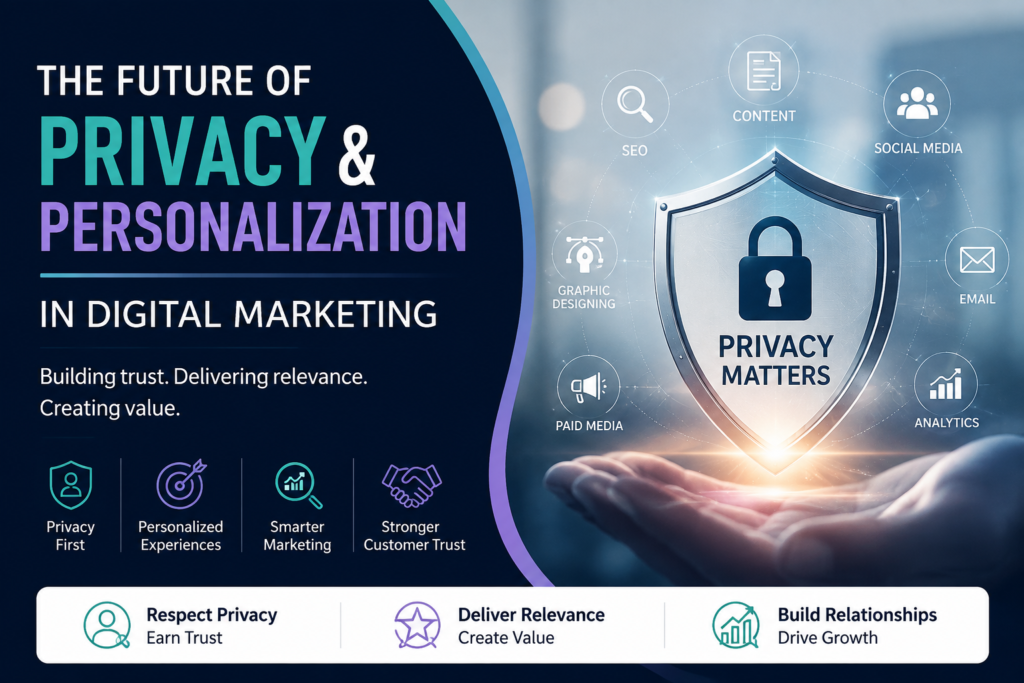
Digital marketing is entering a new era where privacy and personalization are no longer competing priorities—they are becoming two sides of the same customer experience. As consumers become more aware of how their data is collected and used, brands must find smarter and more transparent ways to deliver relevant experiences.The future will belong to businesses that can build meaningful relationships without compromising consumer trust. From SEO and content marketing to graphic designing and paid media, every digital touchpoint will need to balance personalization with responsible data practices.1. Brand Situation Prior to the Privacy TransitionBefore the privacy transition, many brands relied heavily on third-party cookies, extensive audience tracking, and behavioral data to understand consumers. Marketers could follow users across websites, identify their interests, and deliver highly targeted advertisements.While these practices made digital advertising more measurable, they also created growing concerns around privacy and transparency. Consumers increasingly wanted to know what information companies were collecting, why they were collecting it, and how it was being used.This shift has changed the digital marketing landscape. Search engines, browsers, mobile platforms, and regulatory environments have increasingly emphasized user privacy. As a result, businesses can no longer depend entirely on traditional tracking methods.This transition also creates an opportunity. Instead of treating privacy as a limitation, brands can use it to build stronger relationships with customers through transparency, valuable content, and consent-based personalization.2. Strategic ObjectiveThe primary strategic objective in a privacy-first digital environment is to create personalized customer experiences while respecting consumer choice.Brands should focus on collecting quality first-party data through genuine customer interactions. Newsletter subscriptions, website preferences, loyalty programs, surveys, purchases, and voluntary account information can provide valuable insights without relying entirely on third-party tracking.Another objective is to improve the quality of marketing rather than simply increasing the quantity of data. Understanding what customers actually need can help marketers create more relevant campaigns.For example, a company can combine SEO research, customer feedback, website behavior, and content engagement to understand audience interests. Instead of creating dozens of intrusive advertisements, the brand can develop useful resources that answer customer questions and guide them through the buying journey.This approach makes SEO marketing particularly valuable. High-quality, helpful content can attract people who are actively searching for solutions, creating a more natural path to personalization and conversion.3. Campaign Architecture & ExecutionA successful privacy-first campaign begins with a clear architecture built around customer value.The first step is audience understanding. Brands can analyze consented first-party data, customer research, search trends, and engagement patterns to create broad audience segments. These segments should be useful without becoming overly invasive.The second step is content development. Every campaign should offer something meaningful—whether that is an educational article, product guide, video, social media post, or interactive experience.Visual communication is equally important. Strong graphic designing can help transform complex information into simple, engaging messages. A well-designed visual identity can also create consistency across websites, social platforms, advertisements, and email campaigns.For businesses publishing a Graphic designing blog, for example, privacy-friendly personalization can involve recommending content based on voluntarily selected interests rather than silently tracking users across unrelated websites.The execution stage should then connect content, design, search, email, and advertising into a unified customer journey. Testing can focus on engagement, conversions, content performance, and customer feedback while respecting consent preferences.Brands should also make privacy policies easy to understand. Instead of hiding information in complicated legal language, marketers can communicate data practices clearly and encourage customers to make informed choices.4. Media & Channel StrategyThe future of digital marketing will involve a broader mix of channels rather than dependence on a single tracking technology.SEO will remain an important channel because it connects businesses with users who are actively searching for information, products, and services. A strong organic strategy can reduce dependence on invasive advertising techniques by creating long-term visibility through useful content.Search behavior can also provide valuable insights without requiring brands to identify individual users. For instance, businesses can study general search trends to understand customer interests and create relevant content.Social media will continue to play a major role, particularly when brands focus on communities and engagement rather than excessive personal tracking. Email marketing can also become more effective when customers voluntarily subscribe and receive content tailored to their stated interests.Paid advertising will continue evolving toward privacy-conscious targeting methods. Contextual advertising, first-party data, aggregated insights, and platform-based audience solutions can help marketers reach relevant consumers without relying solely on individual-level tracking.Local businesses can also benefit from location-based search intent. Someone searching for “SEO marketing near me” is already expressing a strong interest in a particular service. Businesses can respond with useful local content, optimized business profiles, clear service information, and genuine customer reviews.Even the creative industry is adapting. People exploring Freelance graphic designer jobs may discover opportunities through professional platforms, portfolios, search engines, and industry communities rather than depending exclusively on targeted advertising.5. Positioning & Consumer InsightThe most important consumer insight is simple: people still want personalized experiences, but they increasingly expect brands to respect their privacy.This creates a powerful positioning opportunity for businesses. Instead of saying, “We know everything about you,” brands can communicate, “We understand what you need because you choose to engage with us.”Trust can become a competitive advantage.Brands that clearly explain their data practices, offer meaningful choices, and provide genuine value can create stronger customer relationships. Personalization should feel helpful rather than intrusive.For example, recommending a blog article based on a customer's selected interests can feel useful. Showing the same advertisement repeatedly across unrelated websites can feel uncomfortable. The difference lies in relevance, transparency, and control.Creative communication will also become increasingly important. Graphic designing can help brands communicate privacy choices, consent options, product benefits, and educational information in a visually accessible way. Good design can make transparency feel simple rather than complicated.Looking Ahead: A More Trust-Centered Digital FutureThe future of digital marketing is not the end of personalization. It is the evolution of personalization.Brands will increasingly rely on first-party relationships, contextual intelligence, high-quality content, creative storytelling, and privacy-conscious technologies. SEO, email marketing, social media, graphic design, and paid advertising can all continue to thrive when they are built around customer value.The strongest brands will understand that data is not simply an asset to collect—it is a responsibility to manage.By combining strategic thinking with transparent communication and relevant experiences, businesses can create marketing campaigns that are both effective and respectful. The privacy transition therefore represents an opportunity to build a better digital ecosystem—one where consumers receive meaningful personalization while maintaining control over their information.In this new environment, success will not simply be measured by how much a brand knows about its audience. It will be measured by how much value, trust, and relevance it can create with the information customers willingly share.